
Inside Talbot Property Tax Records
Talbot County property tax work begins by separating valuation from collection. The Tax Assessor sets fair market value, applies the assessment rules, handles returns and exemptions, and issues assessment notices. The Tax Commissioner bills, collects, and runs delinquency and tax-sale administration.
| Field | What It Shows | Where |
|---|---|---|
| Fair market value | Assessor estimate used before Georgia's assessment level. | Assessor roll and notice |
| Assessed value | Forty percent of fair market value under the stated rule. | Assessor roll and notice |
| Exemption | Relief applied to an eligible account. | Assessor record |
| Bill and status | Charge, due date, payments, balance, or delinquency. | Tax Commissioner |
| Tax-sale trail | Advertisement, sale, deed, redemption, and excess-funds leads. | Tax Commissioner and Clerk |
The bill grows out of the taxable framework, not a forecast of what a parcel might sell for, and the recorded deed or PT-61 remains the lead for any prior transfer amount. An exemption shrinks the taxable base. The full fair-market figure stays the same.
Keep each fact on its own line. List the parcel account, tax year, notice date, digest value, assessed value, exemption, bill date, and payment date separately. A year mismatch then jumps out. A payment on one account never clears another parcel, and a corrected assessment may not appear on an older printed bill at once. Ask each office which dated record controls its step.
Talbot's Forty Percent Rule
Georgia real property is assessed at 40 percent of fair market value. That figure comes from Talbot's official tax information. For real figures, check the parcel account and the current notice. Assessed value is not market evidence. It is not the amount due either. Millage rates and exemptions turn that assessed base into the actual bill.
Sale prices can differ for many reasons. Transaction date, property condition, financing, and conveyance terms all move the number. More on what each figure means sits on the Talbot County property value page.
- Fair market value
- The assessor's estimate of full value for the digest.
- Assessed value
- The statutory percentage used in the tax process.
- Homestead exemption
- Qualified relief tied to an application and eligibility.
- Tax lien
- A claim arising from unpaid tax.
Find a Talbot Tax Bill
The Tax Commissioner links qPublic to online payment. The live payment search may restrict access, so confirm its exact fields on the official pay-property-taxes page, then match its account to the Assessor parcel. The tax office itself cautions that its data may be slightly dated and can contain errors or omissions.
- Find the parcel in the assessor search and copy its account key.
- Open the Tax Commissioner bill route and search the same account.
- Compare year, assessed base, exemption, charge, and payment status.
- Contact the office if a recent payment or delinquency is unclear.
- Check the Clerk trail when a tax deed or lien appears.
- Levy or mill rate
- The rate applied in the calculation.
- Tax year
- The annual period for the assessment and bill.
- Payment status
- The posted amounts paid, due, or delinquent.
- Partial payment
- A payment toward the balance, which Talbot accepts.
Bills are generally mailed in October. They come due December 20. Ask for a dated payoff when status matters. Published guidance lists cash, check, and money order, while card use may carry a convenience fee. Confirm the method and total before sending funds. If land changed hands, say whether the request concerns the current bill, a prior owner's payment, delinquent years, or a tax-sale payoff. The mailing address on a bill routes notices but does not replace the latest recorded deed.
Talbot Tax Offices Stay Separate
The Assessor now sits at 11 N. Jefferson Avenue in Talbotton. The Tax Commissioner stayed put at 38 South Jefferson Avenue, with mail at PO Box 147 and phones at 706-665-3240 or 706-665-3280. Published hours run 8:00 a.m. to 4:30 p.m., with lunch from noon to 1:00 p.m. Value and exemption questions go to the Assessor. Bill and payment questions go to the Commissioner.
The Assessor can email prefilled Homestead Exemption, Business Reporting, Boat Reporting, Forest Land Protection Act, and Conservation Use applications. That convenience does not shift collection work.
In person, bring the parcel account, tax year, notice or bill, and any proof the request needs. Ask the right office. The Assessor covers the assessment record and application status, while the Tax Commissioner handles receipts, payment history, delinquent balances, and the excess-funds procedure. Keep two dated response notes. Never confuse the two replies.
The official Assessor page documents the move, the public search, and the application options. It can spare a wasted trip.
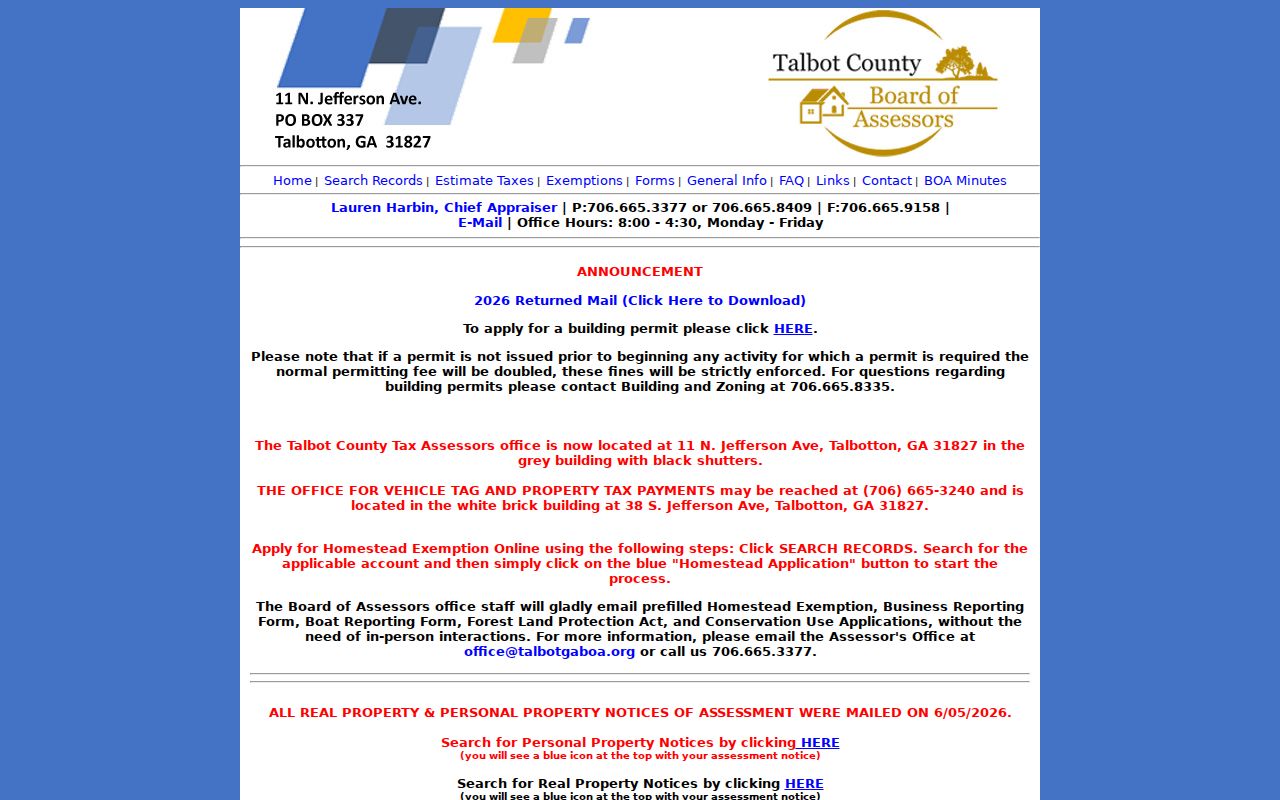
The Assessor page can prevent a wrong-office trip for an assessment record. Note: Confirm whether a question concerns value or collection before contacting Talbot County.
Talbot Homestead Record Trail
Homestead applications are due by April 1. Once granted, the exemption generally renews while eligibility continues. In qPublic, the path starts with "SEARCH RECORDS." Then select the account. Next, click the blue "Homestead Application" button. Confirm the account details before filing. That way the application lands on the right parcel in Talbot County property records.
An exemption flag on the tax roll is a clue, not proof of residence, ownership, or title. Keep the application, the approval, the parcel number, and the tax-year record filed together as one package. Report any move, deed transfer, estate, trust, or entity change to the Assessor. Each can alter eligibility.
The same office supplies prefilled conservation-use and Forest Land Protection Act forms. It also offers business personal property and boat reporting forms. Each form carries its own proof requirements. A submitted form is not an approval. Before the payment deadline, compare the final exemption on the digest against the tax bill for the same year. Ask the Assessor to explain any mismatch.
If the relief never appears, confirm the application parcel. Check the filing date, approval status, and first tax year affected. A deed recorded after the application can change the account or trigger a new eligibility review. Save every letter and the notice showing the Assessor's action. The Tax Commissioner can explain the resulting bill, but exemption questions and assessment-roll corrections belong to the Assessor.
Delinquent Talbot Property Tax
Talbot County treats unpaid ad valorem taxes seriously. Delinquent property can move into the county levy and sale process, and each delinquent parcel is advertised in the Talbotton New Era for four consecutive weeks before auction. The sale itself happens at the courthouse on South Washington Avenue in Talbotton, on the first Tuesday after the final advertisement week, running from mid-morning until mid-afternoon. The Tax Commissioner posts a list of delinquent parcels, though the office publishes no machine-readable version, so a call ahead saves time.
Payment at the sale must be cash or certified funds. Bids are binding under O.C.G.A. §9-13-170, and Talbot County gives no title guarantee on what it sells. Winning a bid does not grant immediate possession or use of the parcel, either.
For any single parcel, capture every newspaper notice, the legal description, the named taxpayer, the tax years covered, the advertised amount, the sale date, the purchaser, and the later deed recording. Search the Clerk index for a tax deed plus any redemption or quiet-title papers that follow. Since no current online list exists, confirm with the Tax Commissioner before trusting an old advertisement as proof a sale is still scheduled.
Talbot Redemption and Excess Funds
A tax-sale buyer may start foreclosing the right to redeem after twelve months. O.C.G.A. §48-4-45 requires notice to the owner at sale. It also requires notice to any occupant and interest holders, plus publication. The Tax Commissioner holds excess funds in escrow. Recorded mortgages and other security interests can shift who has priority.
Treat each step as its own record. Track the advertisement, sale date, tax deed, redemption notices, releases, and court filings separately. Excess funds must be requested in writing. A sale bid or posted assessed value shows neither clear market value nor clear title.
The written request should identify the sale, the parcel, the claimant, and the claimed interest. It should also include whatever records the office requires. Priority can turn on recorded security deeds. So the posted surplus alone does not decide who collects. For redemption, keep certified-mail receipts, publication dates, payoff figures, and any deed or court filing in chronological order. Keep them in order.
Tax sale is not clear title. Redemption and recorded-interest issues can remain after a Talbot sale, so legal review may be needed.
Appeal a Talbot Assessment
The Assessor mails assessment notices each year. The 2026 notices are postmarked June 5, 2026. The appeal window closes July 20, 2026. Follow the notice and current office instructions for the controlling method. Routes may include the Board of Equalization, arbitration, a hearing officer where offered, and Superior Court review.
Assemble the notice, parcel facts, comparable sales, deed records, photos, and condition notes. A dispute over the later tax bill cannot replace a timely challenge to the assessment itself. Compare like property from the same valuation period. Point out any factual error in acreage, structures, use, or condition. If an agent files, confirm the authorization the office requires. Request a stamped or electronic receipt. Keep the envelope or transmission record that proves timing.
2026 appeal window. Talbot notices were mailed June 5, and the published appeal close is July 20, 2026. Verify filing with the Assessor.
Owners may also return property between January 1 and April 1 under the county's cited guidance. A return and an appeal are distinct steps. Keep proof of delivery for anything time-sensitive. The Assessor sets the disputed value. The Tax Commissioner then collects the bill the digest produces. Sending an appeal only to the collection office risks missing the proper process, so ask the Assessor which route applies, what evidence enters the record, and how later board or court notices will arrive.