
Read Talbot County's Owner-of-Record Card
The Talbot County Tax Assessor states that its values reflect the most current published digest. Its parcel search is the practical first stop for an owner-of-record name. Field labels on the live card may vary, though. Read what the card actually displays. Do not assume every expected field appears.
| Owner name | The assessment account's published name and digest context |
|---|---|
| Mailing address | Where assessment or tax correspondence goes, if displayed |
| Situs address | The property location, which may differ from owner mail |
| Account and parcel | Exact keys used to match GIS and land records |
| Legal description | Lot, map, grid, parcel, or abbreviated deed clues |
| Deed or sale reference | A lead to test against the latest recorded instrument |
An owner of record is not necessarily the occupant. Copy the name exactly as the roll shows it, including joint names, punctuation, trust wording, or an entity suffix. The date context matters too. A mailing address offers a contact route, but it says nothing about where the parcel sits.
Confirm the Current Talbot County Owner
The Clerk of Superior Court records deeds and related instruments. Online, GSCCCA and KoFile are the routes. The Clerk at 26 S. Washington Avenue handles office visits, phone, mail, and certified copies, so confirmation stays focused on the newest conveyance.
- Read the owner name and exact account, address, and legal clues from qPublic.
- Search that name in GSCCCA Land Records and check book/page, instrument, date, and property clues.
- Identify the latest deed affecting the same land and read its grantee and legal description.
- If the roll and deed differ, compare dates and contact the Assessor or Clerk.
- Owner of record
- The party an official record identifies as owner in its stated time context.
- Assessment roll
- The assessor's published account record used for value administration.
- Recording lag
- The period before a recorded transfer appears in another county system.
- Vesting
- The way a deed states that an interest is held.
Date the Talbot County Current Owner Result
"Most current published digest" is not a live closing update. Talbot County publishes no fixed owner-refresh schedule. There is also no stated lag. A seller can stay on the roll after the buyer's deed is recorded. Note the assessment year, the page context, and any sale date. Then compare them against the deed's recording date. The official Tax Assessor page is the county-controlled starting point for that dated owner check.
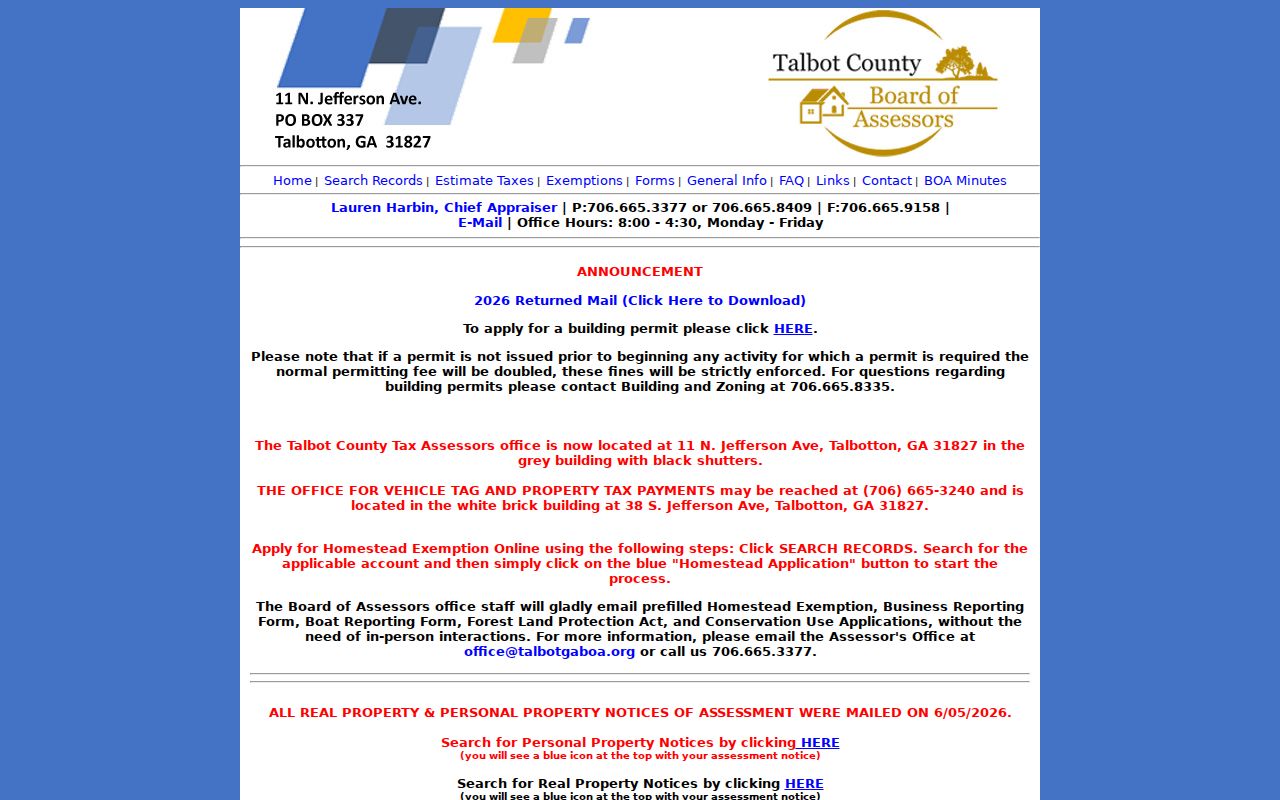
The image points you to the right assessor source. It cannot freeze a parcel card in time, so open the live search, note the digest context, and then compare the latest deed.
Recent-sale gap. A newer recorded deed is the stronger current-owner clue when the Talbot County roll has not caught up, though neither screen is a title opinion.
Cross-Check Talbot County's GIS Owner Field
The Talbot Mail Parcels layer uses ownname1 as its display field. It also exposes acctid, map, grid, parcel, address pieces, legal lines, and date fields. Those details can tie an unclear address to one assessment account. The GIS refresh cycle and what its date fields mean are not documented. Treat the name as another administrative clue. If GIS and qPublic disagree, match the account and legal description. Then rely on the newest recorded deed.
Note: Do not treat polyid as the tax account because it identifies geometry unless the county confirms another use.
Verify Talbot County Entity and Trust Names
An LLC, corporation, trust, or estate can hold current title. Search the exact grantee wording. The Georgia business search supports lookups by business name, control number, registered agent, and officer. Entity status and the registered office help identify the legal party and a contact. Neither the agent nor an officer becomes the owner by that fact alone. A trust may require the deed to identify its trustees. An estate may call for Probate Court authority and a later executor's or administrator's deed, so keep every name tied to the record and date behind it.
Separate Talbot Homestead Status From Current Title
Talbot accepts homestead applications all year. File by April 1 and it can apply to the current billing year. A later filing starts the next year. Approved status renews unless ownership, residence, or exemption facts change. The Board of Assessors decides eligibility. Because of that timing, an exemption can trail a deed. It can also change for reasons unrelated to ownership. Treat it as an assessment clue, never as proof of present title or occupancy.
Monitor Later Talbot County Filings With FANS
The GSCCCA Filing Activity Notification System is free and forward-looking. Register a name or address. Matching filings then trigger a notice. Talbot Superior Court promotes this tool for watching land-record activity. It is not a current-owner database, and it neither validates filings nor prevents fraud. Open any alerted instrument and compare its parcel and legal description. Call the Clerk if it looks unfamiliar. Text matching can flag unrelated filings or miss a spelling variant. Register the exact deed and roll names and date each notice. FANS watches what comes next. It cannot fix an older assessor name or establish the present owner alone.
Request the Talbot County Owner Record Offline
If qPublic is down, call the Assessor at 706-665-3377, visit 11 N. Jefferson Avenue in Talbotton, GA 31827, or write to office@talbotgaboa.org. Request the parcel record and name the digest year you need. For deed records, the Clerk sits at 26 S. Washington Avenue, PO Box 325, Talbotton, GA 31827, and answers at 706-665-3239. No local copy fee is published, so confirm the cost before ordering anything certified.
A request framed under the Georgia Open Records Act can ask for an existing record. The agency then has three business days to respond. It must provide the record or a statement covering its availability, timing, cost, and any exemption that applies. The law does not require the office to build a new report. It will not answer who owns a property.
Mail, phone, and counter service all work when no image is available. Give the Clerk the name, book and page, recording date, and legal description. Ask whether an informational copy suffices or a certified copy is required for your purpose. Talbot County publishes no local deed-copy price, so request the current fee first.
Keep the two offices straight. The Assessor, at 11 N. Jefferson Avenue, sets values and maintains assessment records. The Tax Commissioner, at 38 S. Jefferson Avenue, handles the bills and payments. Route a question to the right office. That keeps a payment record from being mistaken for the assessor's owner of record determination.
Contact a Talbot County Current Owner Lawfully
A written approach about a purchase, boundary, easement, or estate works best through the assessment mailing address. That address is a public-record clue. Keep it separate from the situs. A distant mailing address does not make the owner of record wrong, and the situs alone never proves who actually lives at the property.
Use the record with care. A current-owner result is not a title search. Do not use public owner details to stalk, harass, threaten, or harm a person.
Before acting on a transaction or a contested interest, pull the recorded document. Then get qualified advice. The current owner record is a dated starting point only. It does not guarantee that no other legal interest exists.
Look closely at the deed type. Was it corrective, quitclaim, executor, administrator, or tax-related? The grantee may still be current. Yet the instrument and its exceptions shape what was actually conveyed. An index entry can point to a document. It may not show each reservation, easement, or legal-description detail.
Trusts and estates deserve extra care. Ask for the recorded instrument that vests the present interest. Do not lean on a shortened tax roll label. Probate files may explain who holds authority, but the land filing connects that authority to the parcel. For an LLC, copy the full entity name and control number from Georgia's business search. Then compare both against the deed. A registered agent supplies a contact route. Appearing in the entity record does not make the agent the owner.
Finally, preserve a compact evidence set. Include the qPublic page date or digest year. Add the GIS account and legal fields, the newest deed recording date, and the grantee spelling. Include the Clerk's book, page, or instrument reference too. When two systems disagree, send those exact facts to the Assessor and the Clerk. Each office can then explain or correct its own record rather than produce a new ownership report.