
Deed Types Recorded in Talbot
The Clerk of Superior Court is Talbot County's recording office for land instruments. A deed states the conveyance. It names grantor and grantee, and security deeds, liens, assignments, releases, plats, and court papers may sit beside it affecting the same land. Each has its own job.
| Deed Type | What It Does | Common Use |
|---|---|---|
| Warranty deed | Conveys the stated interest with title promises in its text. | Ordinary arm's-length conveyance. |
| Quitclaim deed | Conveys whatever interest the signer has, without broad promises. | Interest cleanup, family, or corrective transfer. |
| Executor or administrator deed | Conveys under authority arising from an estate. | Probate-connected land transfer. |
| Deed under power | Records a transfer after an authorized foreclosure process. | Security-deed foreclosure trail. |
| Tax deed | Records a tax-sale transfer subject to redemption and title issues. | Delinquent-tax property trail. |
A recorded deed beats an index summary. But recording alone does not guarantee clear title. Read the signatures, the legal description, and the consideration language. Check the execution date, the recording date, and any prior-instrument references. Then search Talbot records for later corrective deeds, releases, court orders, and competing interests that could cloud the parcel.
Instrument date and recording date answer different questions. The first shows when the parties signed. The second shows when the Clerk accepted the deed into the public record. Keep both. Note the preparer, return address, witnesses, notarial details, tax references, and any exhibits. An exhibit may hold the full metes-and-bounds description while the index shows only a short label.
Three Talbot Deed Search Routes
The Clerk's real-estate search page points searchers to GSCCCA and KoFile. GSCCCA runs statewide Name, Book/Page, Property, Instrument Type, PT-61, lien, and plat searches. KoFile is another official county route. The Clerk's counter and written requests still matter when either portal comes up short.
The Georgia statewide deed search went live as a database in 1999. That year does not mark Talbot County's first online records. Search by exact and variant party names. Search by county, book and page, and the property modes offered. Confirm login, premium, image, and certification terms on the live service.
GSCCCA also opens PT-61, lien, and plat routes. Treat PT-61 as a transfer-record lead, not a substitute for reading the deed. Chase any lien-name hit through its cancellation, satisfaction, release, renewal, or court disposition. A plat result needs the recorded image and its amendments. These parallel indexes guard against a narrow deed-name search. They keep it from hiding instruments tied to the same parcel.
This GSCCCA screen shows the official land-record search families.
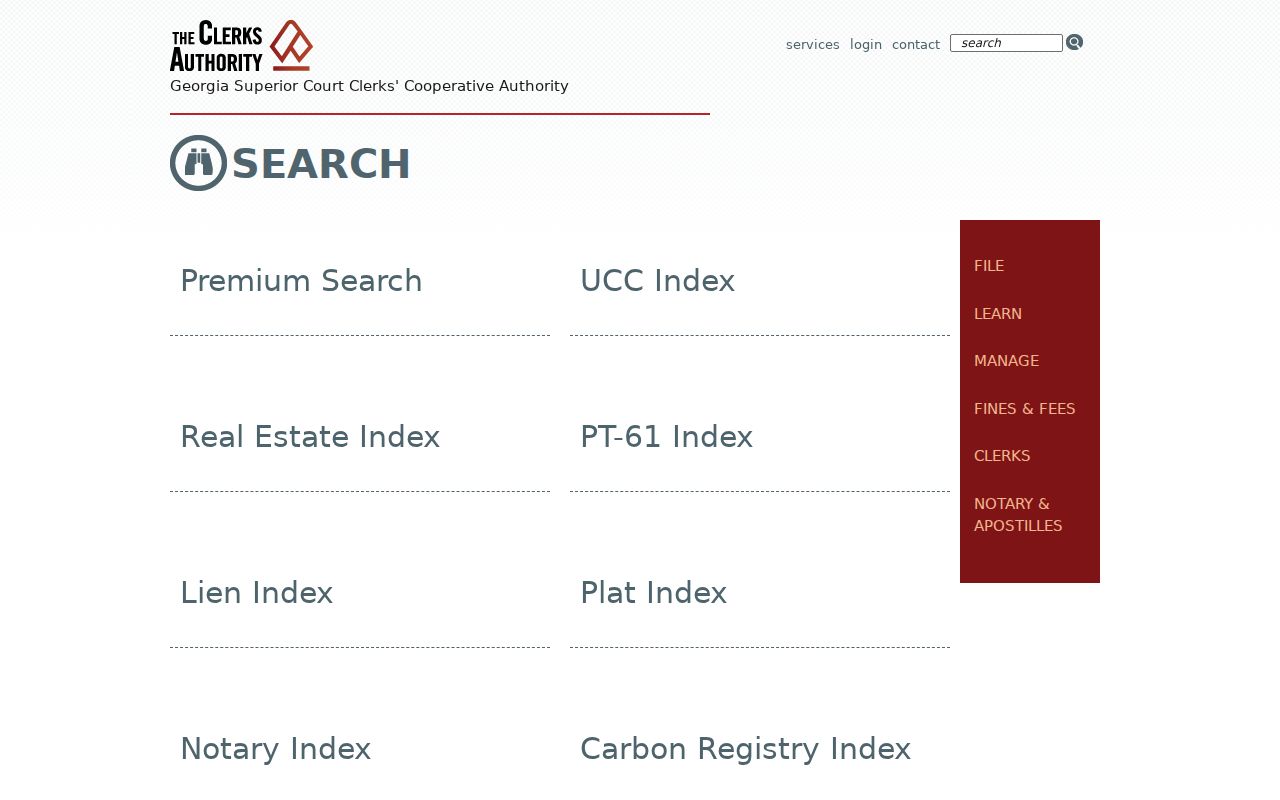
The tabs help you pick an index path. Still, the recorded image and a Clerk-certified copy carry more detail than any result row.
Walk Talbot's Grantor-Grantee Chain
A grantor conveys an interest. A grantee receives it. Trace a Talbot County chain backward from the newest verified deed, not from a tax-roll name alone. At each link, record both party roles, both dates, the deed type, the book and page or instrument reference, and the full land description.
- Find the current owner’s acquisition deed with that owner listed as grantee.
- Read the grantor, legal description, and prior deed reference from the image.
- Search that grantor as an earlier grantee and confirm the same land.
- Repeat while tracking corrections, estates, tax sales, and parcel changes.
- Move to the Virtual Vault, physical books, or archival routes when the online chain ends.
- Grantor
- The party conveying the stated interest.
- Grantee
- The party receiving the stated interest.
- Chain of title
- The linked sequence of conveyances affecting the same land.
- Book and page
- A volume and page locator for a recorded instrument.
- Instrument number
- A unique recording reference used in an index system.
A shared last name proves little on its own. At every link in a Talbot County deed chain, test the details: acreage, lot and block, metes and bounds, adjoining owners, roads, plat map references. Also check any carved-out exceptions. The property record either holds together or it does not.
Even a clean backward chain can snap. Probate, corporate mergers, foreclosures, tax sales, corrective instruments, and court decrees all interrupt the pattern. A grantor who never shows up earlier as a grantee is the tell. Chase estate names, fiduciaries, alternate spellings, and Superior or Probate Court authority when that happens. Talbot annual returns cataloged from 1828 through 1926 can supply historic estate context. File the authority paper and the later recorded deed as separate links. Never compress them into one assumed transfer.
Talbot Virtual Vault's Book Puzzle
The Talbot Virtual Vault organizes its grantee and grantor indexes into letter groups. It also posts Deed Books A, B, C, E, G, and J. No year map accompanies those volumes. A notice on the page adds that older images may be incomplete or hard to read. They serve informational purposes rather than as certified legal copies.
That odd alphabet arrangement puts a premium on careful spelling. Start with the right grantor or grantee range. Then scan neighboring entries for variant handwriting or indexing quirks. Jot down the book locator as you go. A year may not match any listed book. Then ask the Clerk for a volume inventory or hands-on help.
Blurry images call for good notes. Record the index heading, the sequence, the page, and the names on either side. Note any letter you are unsure about before requesting the volume itself. Search both sides of the transaction. A grantor entry that is smeared may read cleanly in the grantee index. Old images can still pin down a locator. The Vault cautions that its material stays informational and possibly incomplete. For a legal or estate decision that turns on exact wording, get the Clerk's copy. The Virtual Vault page shows where the historical collection begins.
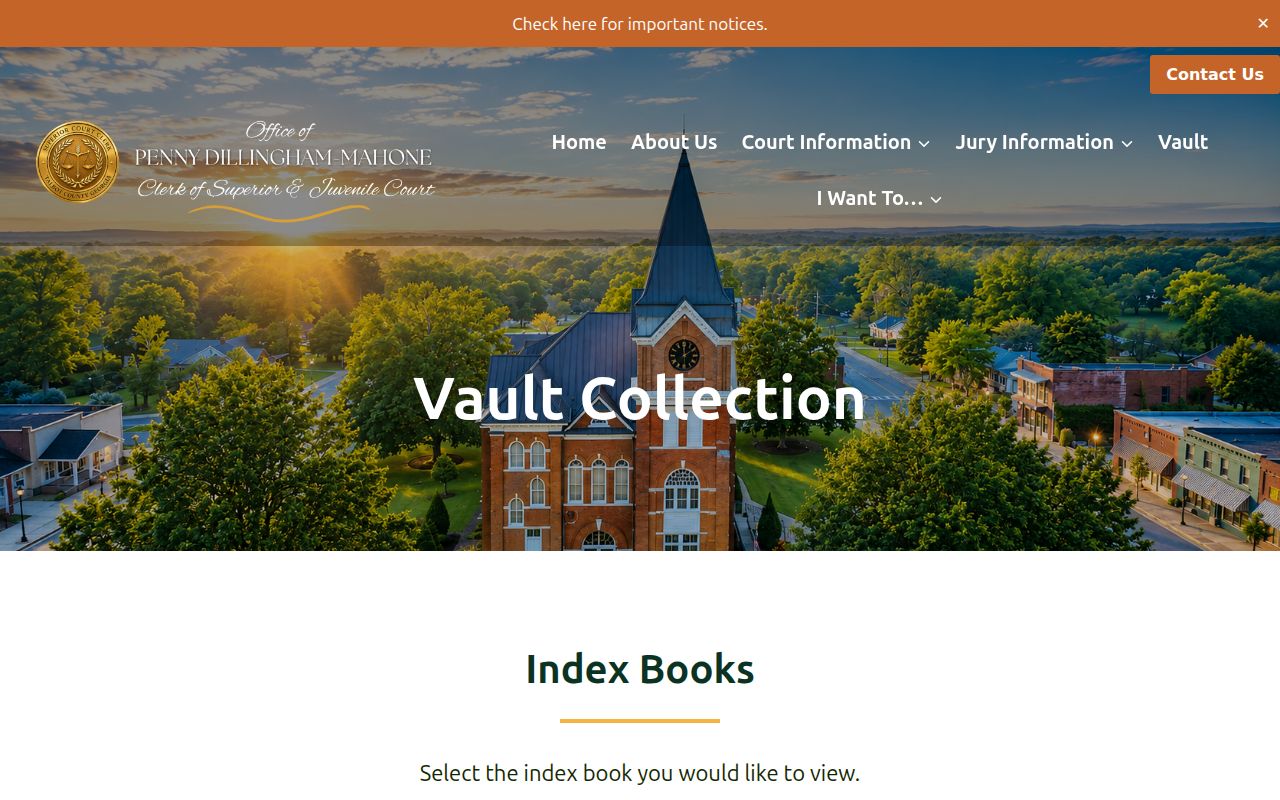
The image shows why the online book list works better as a lead than as a full dated catalog of Talbot County deed records.
Note: Talbot County's earliest online deed year was never published, so never substitute the statewide 1999 launch date for local coverage.
Talbot Deeds and Encumbrances
Track the same names and land clues through later instruments that burden the chain. A security deed often draws followers. Assignments, modifications, releases, satisfactions, and foreclosure deeds all appear in Talbot County deed records. Pair every lien or judgment with its cancellation, release, or court disposition. Easements and covenants can sit inside an older deed or a recorded plat, and they still bind the land even when the GIS map shows nothing.
A tax-sale trail needs the Tax Commissioner's sale procedure, the recorded tax deed, redemption notices, and any later quiet-title case. Talbot County is clear that a tax sale guarantees no title. Redemption generally cannot be foreclosed for twelve months. Statutory notice and publication come first. So a tax deed opens title research rather than ending it.
Plats Clarify Talbot Land
Deeds describe land two ways. A plat fixes lot and block, while metes and bounds trace bearings, distances, and monuments. The Clerk route and GSCCCA Plat Index modes locate the referenced map. Record the subdivision, phase, lot, block, book and page, surveyor, dedication, roads, easements, and adjoining parcels.
GIS fields can bridge a modern account to old deed text. Lot, map, grid, and parcel identifiers help. Clerk references help too. Yet no GIS layer replaces the recorded plat or a licensed survey, and a split or merge can change tax identifiers while old conveyances still carry an earlier description.
Read the plat closely. Dedicated roads, drainage easements, private access, common areas, building lines, and amendments all appear there. Go back to the deed next. Check which exceptions and plat references it incorporates. For metes-and-bounds land, keep every bearing, monument, adjoining-owner call, and exclusion, since a parcel outline may orient the tract while controlling instruments and qualified survey work settle the legal line.
FANS Watches Future Talbot Filings
The Clerk site promotes a free Filing Activity Notification System. FANS sends alerts when new real-estate documents enter the transmitted index. Alerts can follow a registered name. They can also follow a property address. The service looks forward only. It does not search deed history or block a filing. Nor does it promise that every index entry is accurate, complete, or current.
Register likely spellings for future documents. Register addresses too. Then inspect any alert through the official index and the Clerk. FANS raises deed-fraud awareness well. It cannot replace a chain review or title examination, though. The FANS registration page shows the official sign-up and alert service.
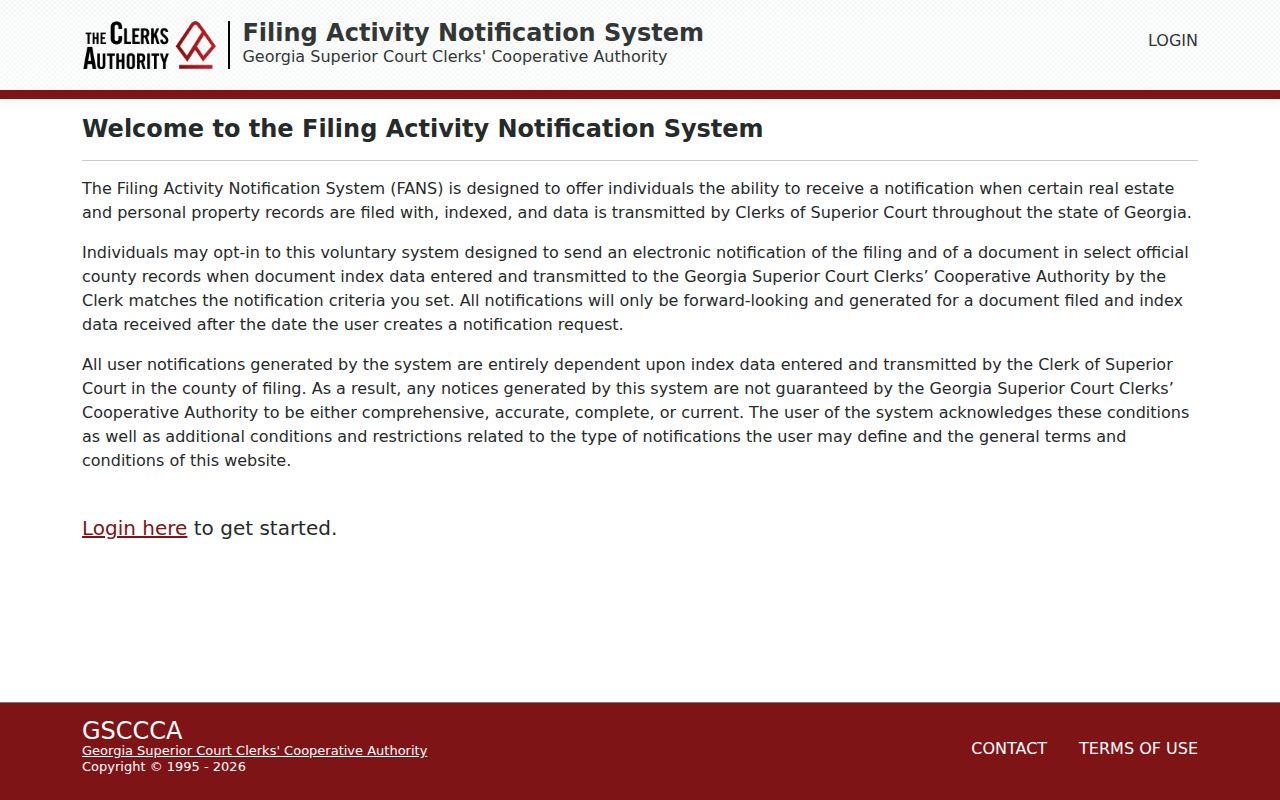
The screen confirms the monitoring route while its notices remain prompts to check the actual filing.
Request a Talbot Deed Copy
Pull the online image first when the portal offers one. Otherwise contact the Talbot County Clerk of Superior Court at 26 S. Washington Avenue, PO Box 325, Talbotton, GA 31807, or 706-665-3239. Say whether a plain or certified copy is needed. Provide party names, an approximate date, and the document type. Include the book and page or instrument number. Add the parcel description. Phone, mail, and counter requests still work when no image exists.
Talbot's official sources post no current deed-copy or certification fee schedule. Ask for the total before ordering. For a wider set of records, a precise request under the Georgia Open Records Act can seek inspection or electronic copies. Request a cost estimate with it. The agency answers within three business days. Production itself may take longer.
Recorded, not guaranteed. Talbot County deed records show filed instruments, but an index or copy is not a title opinion and may not reveal unrecorded interests.
Check the Talbot County property search first. The search confirms the current account and owner spelling before a deed request, while qualified professional help settles any legal question of ownership, priority, or marketable title.