
Follow the Talbot County Address-to-Owner Route
Who owns a Talbot County property? A three-record check answers it. The Talbot County Tax Assessor publishes the current digest and advertises parcel search on its qPublic site. The Clerk's land index supplies the later test: did a newer deed vest someone else after that roll was prepared?
- Normalize the situs address and search qPublic. If there is no match, use GIS address parts to identify the account, map, grid, and parcel.
- Copy the owner name, mailing address, situs address, legal description, account ID, and any deed or sale reference exactly as shown.
- Search the latest grantee through GSCCCA Land Records or KoFile, using name and book/page clues.
- If the grantee is an entity, verify its exact business name and status with the Georgia Secretary of State. Treat the registered agent as a contact, not the landowner.
Do the roll and latest deed agree? Then the owner of record is settled. If not, compare the deed's recording date with the digest's refresh cycle, since a recent closing can outpace the published roll. The fuller present-owner check appears on the current Talbot County owner page.
Start a Talbot County Owner Search With the Place
An everyday address helps, but the Talbot County GIS schema shows why one spelling can fail. It stores street number, direction, name, type, suffix, unit, combined address, premises city, and ZIP in separate fields. Try Road and Rd, or Highway and Hwy. Drop unit text when the search stalls, and keep mailing geography apart from premises geography. Rural land may need a legal description.
Once the GIS service picks a polygon, preserve acctid, map, grid, parcel, lot, and all three legal-description fields. Never guess a parcel number. Talbot has not published its formatting rule. Those exact keys matter. They keep the target tract apart from another property on a similar road name.
Note: A premises or situs address locates land; an owner mailing address is where tax correspondence goes and may be elsewhere.
Read the Talbot County Assessor Owner Clue
The assessor site draws its values from the most current published digest and describes its search as holding a wealth of information. Card labels on qPublic can vary. Find the owner-name line yourself. Record the page's tax year or publication context, and save the account number and legal description. Treat an unlabeled figure with caution. Never invent a label or a refresh date. The official Talbot County assessor page is the entry point to use before following any parcel-search link.
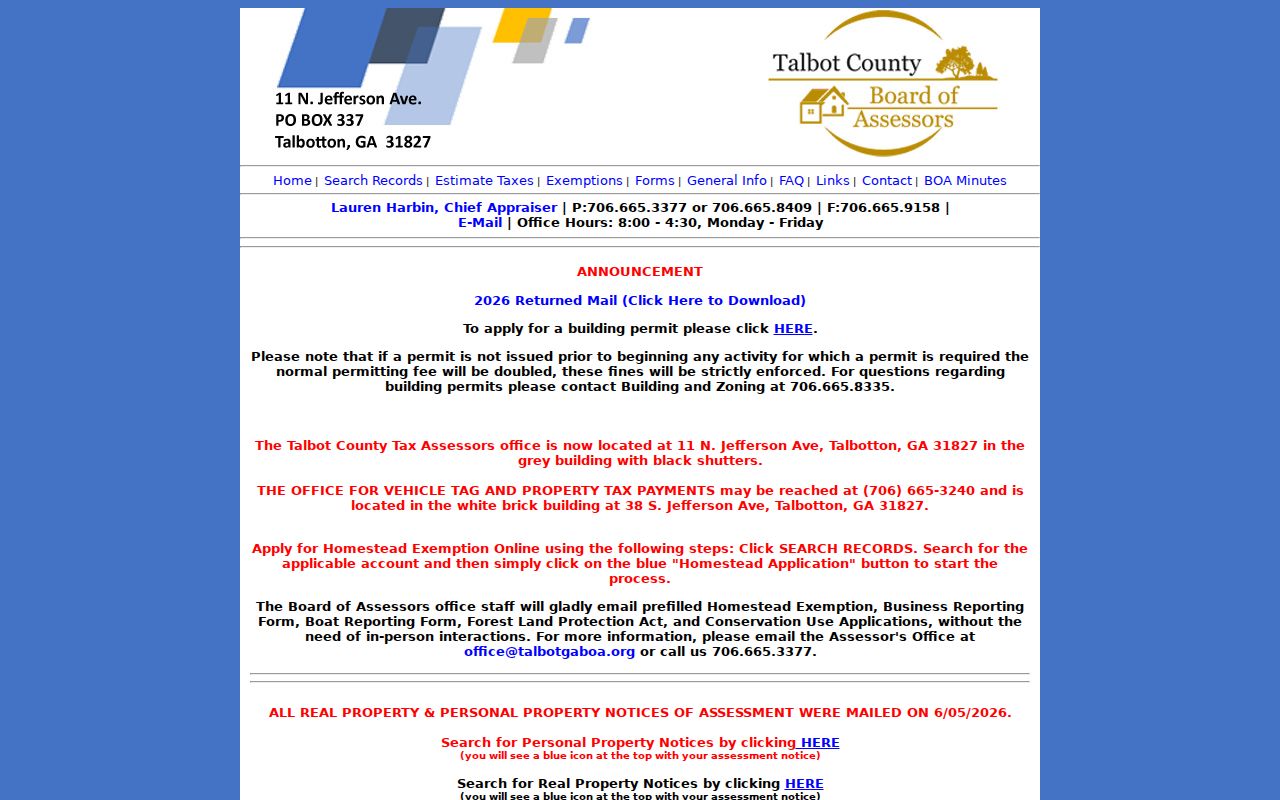
The county assessor page anchors the source, but a parcel result still needs a live reading and a deed check. The GIS layer exposes ownname1 as its display field. That field is a useful owner clue. A name that matches qPublic and the deed index is stronger than any one display. The layer publishes no owner-update schedule. So a conflict means the dates need checking.
Know Where Talbot County Ownership Appears
No single owner search replaces the rest. Each Talbot County source covers one angle. The assessment roll is the fastest current administrative source, the land index points to the recorded conveyance, and GIS connects the name to mapped land. Entity and probate records explain names that do not look like people.
| Where ownership appears | What it contributes | How current |
|---|---|---|
| Assessor and tax roll | Published owner, mailing and parcel clues | Current published digest, which can trail a sale |
| Clerk land index | Latest grantee, instrument, date and book/page | Recorded filing sequence |
| GIS parcel layer | ownname1, account, address and polygon | Refresh cycle not documented |
| Business search | Entity status, control number, agent and office | Corporate context, not title |
The property owner is not always the occupant. A mailing address may belong to an out-of-county owner. An entity's registered office may simply belong to its agent. Use these records to identify and reach the recorded party for a legitimate property matter, not to guess who lives at the site.
Trace Talbot County LLC, Trust and Estate Owners
LLCs, trusts, and estates are not dead ends. Copy the grantee exactly, punctuation and all. The Georgia business search offers Starts With, Contains, and Exact Match modes. It also searches by business name, control number, registered agent, and officer name. A registered agent or office helps you find a contact. Neither proves the agent owns the property.
Trusts name trustees in the deed. The assessment roll may shorten the label, and an estate transfer can require a Probate Court order or administrator authority followed by a recorded executor's or administrator's deed. Talbot Probate Court at 26 S. Washington Avenue holds wills, estates, annual returns, and related orders.
- Owner of record
- The party shown by an official roll or recorded vesting record in its stated date context.
- Grantee
- The party receiving the interest in a deed.
- Title
- The legal rights in property, which a name-only lookup does not fully establish.
- Situs address
- The location of the property, distinct from the owner's mailing address.
Use Talbot County Homestead Data as a Limited Clue
Talbot County accepts homestead applications all year. An initial application filed by April 1 applies to the current billing year, while a later filing begins the next year. Approved exemptions renew automatically unless ownership, residence, or exemption facts change. The Board of Assessors makes the final eligibility decision.
Homestead status can support an owner-occupancy inference for a given tax year. It does not prove title. A deed can be newer than an exemption record, and not every owner or parcel qualifies. Keep the clue in its assessment context.
Watch Future Talbot County Filings With FANS
The GSCCCA Filing Activity Notification System is a free alert tool. The Talbot Superior Court site promotes it. Register a name or an address. FANS then sends notice when a matching filing enters the statewide system. For a Talbot County owner of record, that early heads-up can flag a later deed, a lien, or another land-record event. It beats being surprised.
Keep the tool in perspective. FANS is monitoring, not historical research and not fraud prevention on its own. It will not establish who owns a parcel now. It will not validate an instrument or replace a title examination. When an alert arrives, take it to the Clerk. Compare the recorded document against the parcel number and legal description.
Note: Name and address alerts depend on matching text, so register useful variants and review each notice against the actual parcel.
Ask Talbot County for the Missing Owner Record
Portals let you down sometimes. When qPublic, KoFile, or the GIS map fails you, go straight to the offices that hold the originals. The Talbot County Assessor sits at 11 N. Jefferson Avenue in Talbotton, reachable at 706-665-3377 or office@talbotgaboa.org. The Clerk of Superior Court keeps the deed records at 26 S. Washington Avenue, PO Box 325, Talbotton, with a phone line at 706-665-3239. Have your details ready before you call. Staff can pull a parcel record or deed fastest when you supply the exact owner of record, account number, book and page, or date.
There is also a formal path. A request under the Georgia Open Records Act obligates the agency to respond within three business days, either producing the record or explaining its timing, cost, and any legal exemption. The first 15 minutes of staff time cost nothing, paper copies generally top out at $0.25 per page, and the agency has no duty to build a new report from scratch.
Respect the Limits of a Talbot County Owner Lookup
A who-owns search has real reach. It can surface the name on a tax roll. It can show the grantee in a recorded deed, and the entity behind state filings. What it cannot do is certify clear title. It cannot prove the named party lives on the land. It cannot settle competing legal interests, nor promise that a recent transfer has reached every database. Protected identifiers may also be redacted under Georgia law. So some owner details stay shielded by design.
Ownership is not a name alone. Use Talbot County owner records for lawful property research. A roll result is not a title search, and no public detail may be used to stalk, harass, or harm someone.
For a purchase or an estate decision, pull the recorded instruments themselves and get professional advice where interests tangle. The Talbot County deed records guide lays out that proof path without turning an owner-finding method into a full chain search.
Tax-sale and probate transfers demand extra care. A tax-sale purchaser can face redemption and quiet-title questions. An estate name may rest on a Probate Court order and a later administrator's deed. Copy exact names, dates, and the legal description into the Clerk search, because a sale notice, annual return, tax bill, or probate filing is not the final ownership instrument when a recorded conveyance is required.